 PRODUCT TALES // IT-FICTION
The Hacker’s Log
Part 3 of the Security Theatre Saga: An external penetration tester spots the notorious CVSS 9.8 vulnerability from Part 1—only to collide head-first with real-world Defense-in-Depth.
PRODUCT TALES // IT-FICTION
- Perspective: External Penetration Tester (Black-Box Assessment)
- Target: CoreShift Systems Enterprise SaaS
- Core Friction: Theoretical vulnerability ratings vs. real-world exploitability and Defense-in-Depth architecture.
Log Entry: Day 3 — 14:20 UTC
I rubbed my hands together. There it was in the scanner output: a published, infamous CVSS 9.8 Critical Vulnerability inside a third-party XML parsing module running on CoreShift’s public edge endpoint.
On paper, this was a jackpot. A 9.8 score meant remote code execution, full system compromise, and an easy report payout. The compliance auditors had probably been screaming about this for months.
I crafted the exploit payload, fired the request, and waited for my reverse shell.
Log Entry: Day 3 — 14:22 UTC
Blocked. HTTP 403.
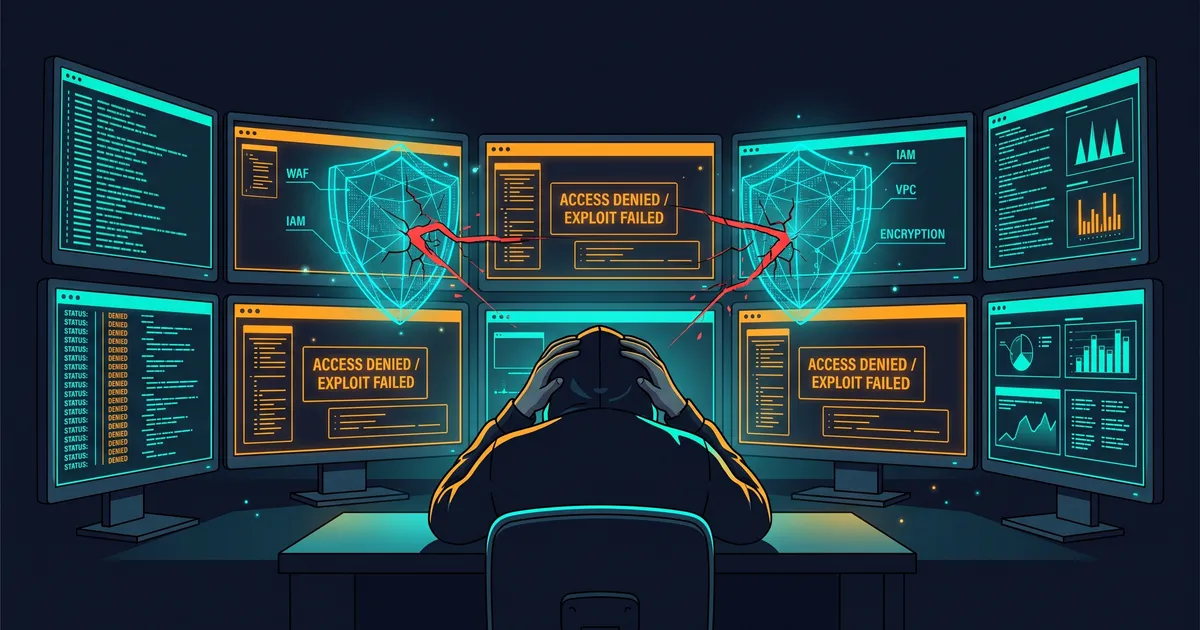
The WAF at the ingress layer inspects payload structure and dropped the malformed XML payload before it even touched the application process.
Fine. I spent two hours obfuscating the payload, encoding the XML entities, and fragmenting the HTTP packets. Second attempt: payload accepted. HTTP 200.
I held my breath, waiting for the outbound TCP connection back to my listener node.
Nothing.
Log Entry: Day 3 — 16:45 UTC
The remote code execution actually triggered inside the isolated container—I could tell by the execution delay. But the attacker’s classic next step—calling home to pull down an attack toolkit—was completely neutralized.
CoreShift’s cloud architects had locked down the VPC with strict Egress Security Group rules. The container had zero outbound internet access. It couldn’t talk to external IP addresses, couldn’t resolve external DNS, and couldn’t fetch an external binary. It was trapped in a digital Faraday cage.
Log Entry: Day 4 — 11:10 UTC
If I couldn’t get a shell out, I’d extract customer database credentials locally.
I executed a local script to read environment variables and IAM metadata.
AWS_SECRET_ACCESS_KEY: Null.- Pod Service Account Tokens: Bound strictly to a scoped role with read-only access to a single S3 staging bucket containing public static assets.
No database passwords in memory. No cluster-admin privileges. The microservice was running under a strict Least-Privilege IAM profile.
Even when I managed to force a direct query to the tenant database layer via local socket forwarding, the sensitive fields returned as encrypted blobs. Key Management Service (KMS) envelope encryption meant raw database access yielded nothing without KMS decryption privileges—which the compromised pod did not possess.
Log Entry: Day 5 — 17:00 UTC (Final Assessment Report)
I closed my terminal and drafted the final penetration test report.
- Headline Vulnerability: CVSS 9.8 (Critical) XML Parser Vulnerability.
- Actual Business Risk: LOW.
- Findings: Exploitation yields no data exfiltration, no lateral movement, and no escalation of privilege due to robust defense-in-depth controls (Ingress WAF, VPC Egress Isolation, Least-Privilege IAM, and Envelope Encryption).
The compliance dashboard flagged this 9.8 rating as a “catastrophic emergency.” But in reality, CoreShift’s architecture treated the vulnerable component like a harmless firecracker inside a blast-proof safe.
The Untangled Takeaway
A CVSS score measures the theoretical severity of a flaw in isolation—not its real-world exploitability inside your specific architecture.
When engineering teams build layered Defense-in-Depth (network isolation, strict IAM, encryption, egress filtering), a “critical” dependency vulnerability often carries zero actual business risk. True security leadership prioritizes architectural isolation over the panic of raw compliance scores.