 PRODUCT TALES // IT-FICTION
The Test Coverage Trap (Part I): The Three-Week Freeze and Project Fortress
How FlowGrid Technologies reached an operational standstill due to manual regression, leading to a tense boardroom showdown and an executive decree that ignored technical warnings.
Every enterprise software company reaches a moment of operational panic where the release cycle transforms from a competitive advantage into a high-stakes liability.
In the early startup years at FlowGrid Technologies, releases were fluid. Developers pushed code directly to production multiple times a day, hotfixes were deployed in minutes, and early customers tolerated minor UI hiccups in exchange for rapid feature innovation.
But as the core product, FlowGrid Enterprise, scaled toward $15M in Annual Recurring Revenue, the math changed completely.
The customer base shifted from agile startups to enterprise compliance teams, global logistics providers, and tier-one financial institutions. For these clients, a minor regression in financial workflows was not a momentary inconvenience—it was a breach of SLA, a data governance risk, or a multi-thousand-dollar operational disruption.
This is the story of how an engineering organization attempted to solve its release anxiety once and for all, and how a well-intentioned executive decree set the stage for a multi-year delivery crisis.
Act I: The Night of Row 618
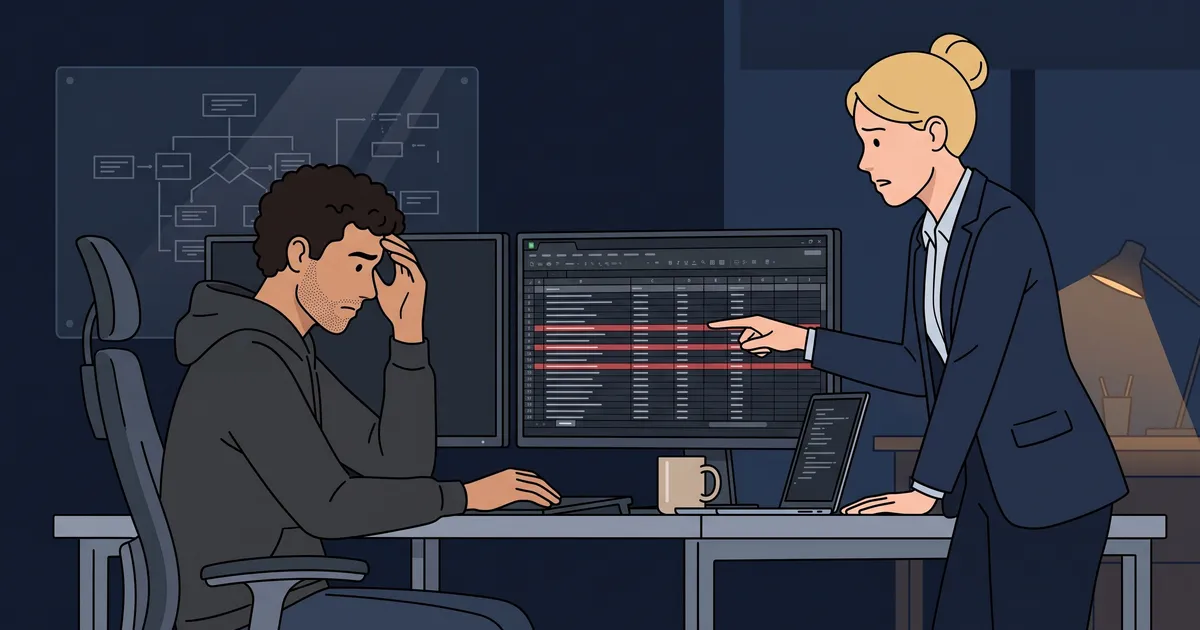
It was Thursday evening at 7:45 PM, two weeks into the Q2 code freeze. The sixth-floor office of FlowGrid Technologies was dark, save for the soft glow of desk lamps and the glass whiteboard covered in system flowcharts.
Alex Rivera, Team Gamma’s Tech Lead, slumped in his chair, rubbing his forehead in frustration. On his dual monitors sat the two pillars of FlowGrid’s release process: on the left, the staging build of FlowGrid Enterprise; on the right, an endless, dark-mode Google Sheet highlighting hundreds of red manual test failures.
Beside his desk stood Elena Rostova, Head of QA.
“Alex, look at Row 618,” Elena said, her voice tight with exhaustion as she pointed at the red highlight on his screen. “It says: Apply multi-currency discount to non-standard VAT invoice, export to PDF, verify rounding logic down to the fourth decimal place. When we click Export, the PDF rounds to two decimals instead of four. Is that a breaking bug, or did the billing engine spec change last month?”
Alex leaned in, staring at the screen. He couldn’t remember. The billing module had been modified by three different developers across two quarters.
“I don’t know, Elena,” Alex admitted quietly. “We’d have to trace the commit history back to March. Mark it as ‘Ambiguous Failure’ for now and move to Row 619.”
This was the reality of the Three-Week Code Freeze.
To protect the business from production defects, VP of Engineering David Chen had mandated that twenty-one days prior to any planned release, all feature development across FlowGrid must halt.
For 15 business days, Team Gamma’s developers sat in a defensive holding pattern, standing by to fix regressions while Elena and her team clicked through thousands of rows in the spreadsheet.
Click by click. Form by form. Environment reset by environment reset.
By day eleven of manual testing, human fatigue was inevitable. Sensory overload meant that subtle edge cases were routinely overlooked—not out of carelessness, but because human eyes glaze over after staring at 1,800 identical web forms.
Act II: The $450,000 War Room
The system broke on a Tuesday at 3:15 AM.
A week earlier, a developer in Team Gamma had submitted a small hotfix during the final days of the code freeze. The pull request addressed a minor CSS alignment issue on the user settings panel. Because it was categorized as a “low-risk UI cosmetic tweak,” it was approved without re-running the three-week manual regression checklist for the underlying billing engine.
Nobody realized that the UI component shared a legacy state-management hook with the recurring checkout pipeline.
At 3:30 AM, CEO Marcus Vance was awakened by an urgent phone call from the VP of Customer Success. FlowGrid’s largest enterprise account—a global logistics conglomerate accounting for 12% of total ARR—had just experienced a catastrophic billing failure.
Over 1,200 automated recurring subscription runs had silently failed overnight. More than $450,000 in monthly charges failed to process, and FlowGrid’s system had automatically generated and emailed invalid cancellation notices to thousands of the client’s end-users.
By 4:00 AM, the executive war room was filled with the smell of burnt coffee and visible panic.
Marcus Vance sat at the head of the conference table, his laptop open, listening to an enraged client CFO over the speakerphone. Beside him, Alex Rivera was frantically typing terminal commands, trying to patch the state-management hook while David Chen attempted to quantify the blast radius.
The immediate technical fix took six hours. The reputational damage took months. FlowGrid was forced to issue $80,000 in service credits, and the executive team spent weeks defending the company’s operational credibility.
Act III: The Boardroom Showdown
The following Monday at 9:00 AM, Marcus Vance summoned David Chen, Elena Rostova, Product Lead Tom Miller, and Tech Lead Alex Rivera to the executive boardroom.
Marcus didn’t sit down. He paced in front of the whiteboard, his expression dark.
“We are spending millions on engineering capacity,” Marcus began, his voice tight. “Yet we spend half our calendar year frozen in manual testing, only to leak a $450,000 defect that nearly loses us our anchor account. Manual testing is an obsolete, human-error-prone bottleneck. It ends today.”
Elena Rostova immediately opened her tablet, presenting a deck she had been preparing for months: Project Fortress.
“I agree completely, Marcus,” Elena said confidently. “The answer is total automation. We pause roadmap feature delivery for four months. We reallocate Team Gamma and the entire engineering staff to translate all 1,824 rows of our spreadsheet into automated, end-to-end Playwright browser scripts. When we hit 100% test coverage, we eliminate manual code freezes forever.”
Tom Miller, Product Lead for Team Gamma, shifted uncomfortably in his chair.
“Marcus, wait,” Tom interjected. “Pausing Team Gamma’s roadmap for four months means killing the European multi-entity invoicing module. We promised that feature to three major pipeline prospects for Q4. If we freeze features now, those deals walk.”
Marcus turned to Tom instantly. “What good is closing European deals if our billing engine leaks half a million dollars every quarter, Tom? If we don’t fix quality now, we won’t have a product to sell. Quality comes first.”
Tom caved, lowering his head.
Seeing the product lead back down, Alex Rivera leaned forward, locking eyes with VP of Engineering David Chen.
“David, please listen to me,” Alex said firmly. “Project Fortress is an architectural trap. Automating 1,800 UI flows in Playwright doesn’t make our architecture clean—it locks a brittle monolith into an ultra-fragile test suite. UI selectors change every single sprint. If we build a top-heavy E2E pyramid, we won’t get instant deployments. We will spend 60% of our future engineering capacity maintaining broken test scripts.”
David Chen waved his hand dismissively.
“Alex, you’re looking at this through a pessimistic technical lens,” David replied smoothly. “Modern E2E automation frameworks like Playwright are incredibly robust. Top Silicon Valley companies automate their entire user flows. Once the scripts are written, our CI pipeline will validate the entire platform in four hours while we sleep.”
“It’s not about the tool, David, it’s about boundary isolation—” Alex tried to counter, but Marcus raised his hand, cutting him off.
“The decision is made,” Marcus declared. “Project Fortress is approved. Tom, clear Team Gamma’s roadmap and manage prospect expectations. Alex, Elena, align the engineering squads. In four months, I want a green dashboard and zero manual testing.”
The meeting was adjourned.
As Alex Rivera walked out of the boardroom into the open-plan office, he saw his team preparing for the upcoming sprint. Management believed they had just unlocked unlimited delivery speed.
In reality, they had just signed off on a maintenance trap that would paralyze FlowGrid Enterprise for the next two years.