 PRODUCT TALES // IT-FICTION
The Test Coverage Trap (Part III): Dismantling the Fortress
How FlowGrid Technologies tore down a brittle 100 percent E2E test suite, replaced it with contract isolation, and reclaimed their engineering velocity.
The executive boardroom on the 24th floor was dead silent. On the projector screen, Marcus, the Lead Backend Engineer, displayed two numbers side-by-side.
42 minutes: The current build and E2E regression time on the main branch.
68 percent: The percentage of pull requests currently bypassing the CI/CD pipeline via --no-verify.
For four months, FlowGrid Technologies had lived inside an administrative cage disguised as a green dashboard. The infamous $450k billing leak had triggered a panic-driven mandate for 100 percent E2E test coverage. Instead of a bulletproof platform, thirty engineers had built a fragile monolith of brittle Playwright assertions, flaking against localized European date formats, third-party API rate limits, and constantly shifting UI components.
Mark, the CPO, stared at the screen, his jaw tight. “We spent a quarter and half our engineering capacity on this test suite to guarantee compliance. You’re telling me we need to tear it down?”
Marcus didn’t flinch. “We aren’t tearing down quality, Mark. We’re tearing down theater. Our developers aren’t writing features anymore—they’re babysitting asynchronous browser hooks just to ship a hotfix to staging. The fortress isn’t protecting us; it’s starving us out.”
The Compliance Friction
The pushback was immediate. The VP of Risk and Compliance shifted in her chair. “If we delete the UI tests, how do we prove to the auditors that the payment gateway actually works before it hits production?”
It was the classic enterprise trap: equating high test line-item counts with actual system resilience.
Marcus laid out the brutal truth on the whiteboard. The breaking point hadn’t been a subtle code bug; it had been the midnight deployment of the multi-currency checkout engine. While the automated suite reported a pristine green status, real customers encountered 502 Gateway Timeouts. The heavy staging mocks had choked under real-world concurrency. The test suite wasn’t catching regressions—it was acting as a massive tax on cognitive load, giving a false sense of security while ignoring infrastructure realities.
“When a system’s safety mechanisms become so hostile to daily workflow that engineers routinely bypass them just to do their jobs,” Marcus explained, “governance has devolved into a liability.”
The Architectural Shift: Dismantling the Pyramid
FlowGrid needed a radical correction. Over the next two sprints, Marcus and Sarah, the Senior Backend Architect, executed a controlled demolition of their testing philosophy, modeled around three strict pillars:
- Ruthless E2E Trimming: They deleted nearly 80 percent of the top-heavy UI test suite. E2E tests were restricted strictly to a handful of mission-critical “happy paths” (e.g., authentication, raw checkout submission). Everything else was pushed mercilessly down the testing pyramid.
- Contract Isolation and API Mocks: Instead of relying on fragile browser automation against volatile third-party services like Stripe, they implemented rigorous consumer-driven contract testing (using Pact) and deterministic local service mocks. Microservices were forced to prove adherence to shared API contracts before integration, catching breaking changes in milliseconds, not minutes.
- Redefining ‘Done’: Readiness criteria were entirely rewritten. A pull request no longer required passing a 40-minute browser farm execution. It required passing isolated unit tests, strict TypeScript compilation, infrastructure compliance checks via Terraform linters, and clean component-level boundary verification.
The Return of Velocity
By the end of the month, the transformation was palpable.
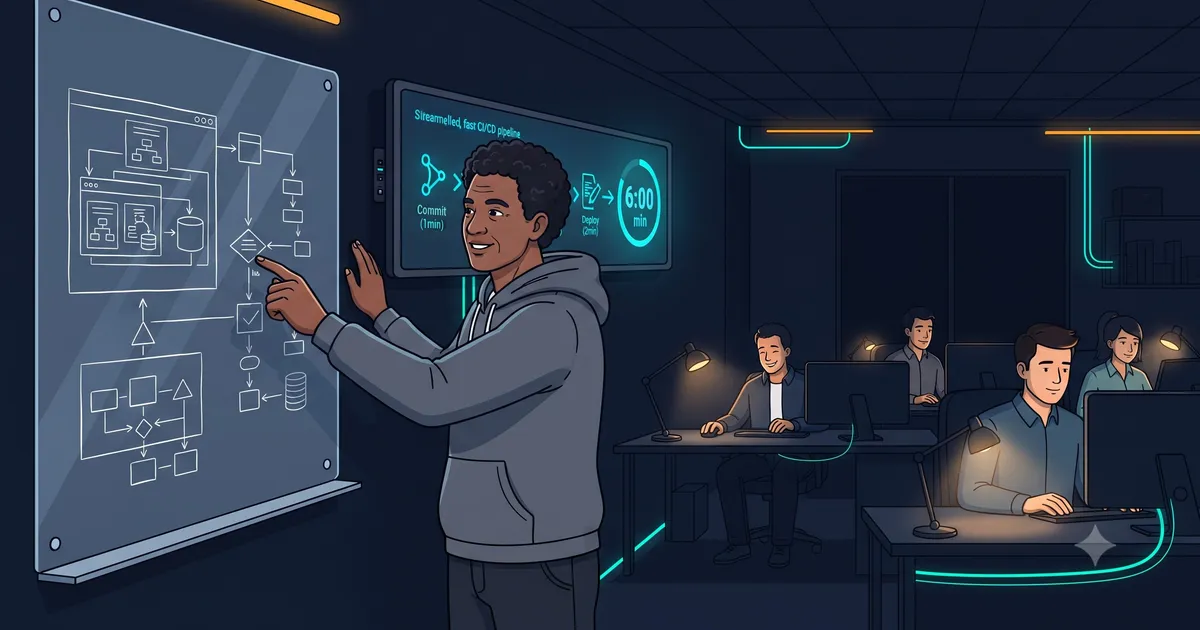
The CI/CD build time plummeted from 42 minutes down to a predictable 6 minutes. The #eng-triage Slack channel, once a relentless waterfall of automated panic and failed assertions, fell quiet. Developers stopped aliasing --no-verify into their bash profiles because the pipeline was fast and reliable again.
In the next engineering all-hands, Marcus pulled up the new executive dashboard. It wasn’t plastered with a vanity metric of “100% E2E Coverage” anymore. Instead, it tracked what actually mattered: deployment frequency, lead time for changes, and mean time to recovery (MTTR).
True product governance isn’t about building an unbreakable fortress that imprisons your own team. It’s about building a sustainable, modular runway that lets your engineers fly faster, safer, and with absolute confidence in the code they ship.
Tale Takeaways (The Test Coverage Trap Saga):
- The Mandate Trap: Top-down decrees for “100% coverage” often create quality theater. Resilience cannot be legislated by a single vanity metric without risking total operational standstill.
- The Maintenance Tax: Heavy E2E UI tests are inherently brittle, failing on localized data and third-party rate limits rather than logic bugs. When test maintenance paralyzes your deployment cadence, automation becomes a cage.
- Subversive Workarounds as Signals: If developers routinely bypass CI/CD gateways (like aliasing
--no-verify) just to survive a sprint, your governance process is actively blocking value delivery. - Dismantling the Pyramid: Reclaim velocity by aggressively pushing tests down the pyramid. Replace fragile browser automation with consumer-driven contract testing (e.g., Pact) and isolated component checks to ensure safe microservice integration in milliseconds.